
Two days to try it out for free
Take structured online classes with experienced teachers to learn the timeless art of Arabic calligraphy.
Learn how to write beautiful scripts, learn about the spiritual history of Islamic calligraphy, and improve a skill that takes time, discipline, and creativity. You can learn at your own pace from anywhere in the world with flexible live class times. People of all ages and backgrounds trust our online calligraphy classes to help them learn or get better.
What do our online calligraphy classes teach?
Arabic calligraphy is one of the most respected forms of Islamic art. Using beautiful writing styles keeps the beauty of the Arabic language alive. Students learn the basics of traditional calligraphy by looking at real-life examples in these classes.
You will learn:
How to use and care for the qalam (reed pen) the right way
How to make ink and learn about writing tools
We used the mizan (proportional scale) to check that all the letters were the same size.
Managing the strokes, spacing, rhythm, and arrangement
The past and present of classical scripts like Thuluth, Naskh, Ruq'ah, and Diwani. How calligraphy shows that you are disciplined, patient, and focused on the spiritual.
Students learn about history and art and do things in every class.
Arabic calligraphy is still important now.
In a world where typing and screens are everywhere, handwriting and sacred arts are becoming less common. You can relax, focus, and get your creative juices flowing again with calligraphy.
A lot of people have trouble with:
Not being able to concentrate: It's hard to really focus when you keep getting pulled away from what you're doing. When you do calligraphy, you learn to be patient and pay attention to what's going on around you.
People who want to make art but don't know how to are creatively stuck. You can see how far you've come with calligraphy because there are clear rules.
Stress and mental fatigue: Writing in a controlled, repetitive way can help you feel better and calm down.
Disconnection from heritage: A lot of Muslims want to feel more connected to their Islamic heritage and the beauty of the Arabic language.
Our classes teach students how to be disciplined, skilled, and appreciate a sacred artistic legacy.
What Students Will Learn
Module 1: Starting to Learn How to Write in Arabic
What You Will Find Out:
Students learn about the different types of Arabic calligraphy, its history, and why it is important to Islam.
What Students Will Learn:
A good understanding of why calligraphy is useful, pretty, and important.
Module 2: Tools for Calligraphers
What You Will Learn:
This module teaches you about the qalam (reed pen), ink, paper, how to sit, how to hold your hand, and how to set up your workspace.
What Students Will Learn:
Students will learn how to use traditional tools correctly and get ready to write.
Module 3: How to Use the Pen and Strokes
What You Will Learn:
Students practice moving in a controlled way, as well as in straight lines, curves, controlling pressure, and pen angles.
What Students Will Learn:
Better control of your hands, steadiness, and confidence in your pen.
Mpodule 4: The Arabic letters
What You Will Learn:
Students start to write Arabic letters that are the right size and shape.
What Students Will Learn:
The ability to write letters correctly and often.
Module 5: Putting letters together to make words
What You Will Learn:
Students learn how to connect letters, space them out, and make words fit together.
What the students will get:
The ability to write full words in a neat and organized way.
Module 6: Different Kinds of Classical Scripts
What You'll Learn:
This module is about well-known scripts like Diwani, Naskh, Thuluth, and Ruq'ah. It tells you how to use them and what makes them unique.
What Students Will Learn:
Finding out about the different kinds of calligraphy and when to use them.
Module 7: Writing and decorating layouts
What You'll Find Out:
Students learn how to make pages, line up text, add borders, center their work, and show it off in a creative way.
What Students Will Learn:
The skill to make beautiful works of art out of writing.
Module 8: Final Projects and Mastery
What You'll Learn:
Students write their own calligraphy pieces and get feedback from their teachers to make them better.
What Students Will Learn:
The confidence to keep practicing on your own and make calligraphy pieces that are good enough to show off.
Our Teaching Methodology
Every session includes:
-
Warm-up stroke drills (3 min) – Trains muscle memory.
-
New letter/rule demonstration (7 min) – Instructor draws, you watch.
-
You draw live (15 min) – Instructor observes via webcam.
-
Correction overlay (5 min) – Instructor marks directly on your digital canvas.
-
Homework & recording – You keep the session recording for review.
Tools used: Paper + reed pen (recommended) OR tablet + stylus. We teach both.
Course Details
| Detail | Information |
|---|---|
| Course Duration | 3 to 6 months (depending on student pace) |
| Class Frequency | 5 days per week (Monday to Friday) |
| Class Duration | 30 minutes per session |
| Class Type | 1-on-1 Live Online |
| Teachers | Male & Female Available |
| Age Group | Kids (4+) and Adults |
| Language | Urdu / English / Arabic |
| Certificate | Yes, upon completion |
| Free Trial | 2 Days Free Trial |
Why Choose Al-Huda Digital Solutions
We're not just another site that offers online calligraphy classes. We at Al Huda Digital Solutions think that being honest, making things easy to find, and giving students the tools they need to learn in a way that matters are all important.
Qualified and Helpful Teachers
Our calligraphy teachers are skilled, patient, and have worked with students of all ages and skill levels. They help each student one-on-one so that they can get better over time.
Fees that are fair and have a reason
We make sure that our class fees are fair and useful. Every payment helps pay for the schooling of kids who can't afford to go to school.
No money or gifts from outside sources
We don't need donations or sponsors from outside sources. We use tuition money to keep our programs going, and it also helps pay for free schooling for girls at Madrasa Khadija-tul-Kubra.
Times for class that work for you
Students from all over the world can learn at their own pace because there are classes every day of the week, from morning to night.
Free Class
You can come to a free trial class before you sign up to see how we teach and what the classroom is like.
Give Power Your Attention
We teach students, especially girls and women, useful artistic skills that they can use to improve themselves, teach others, work on their own, or make money from home.
Not Only Calligraphy
When you choose us, you're not just learning Arabic calligraphy; you're also joining a tradition that changes lives through creativity, discipline, and learning.
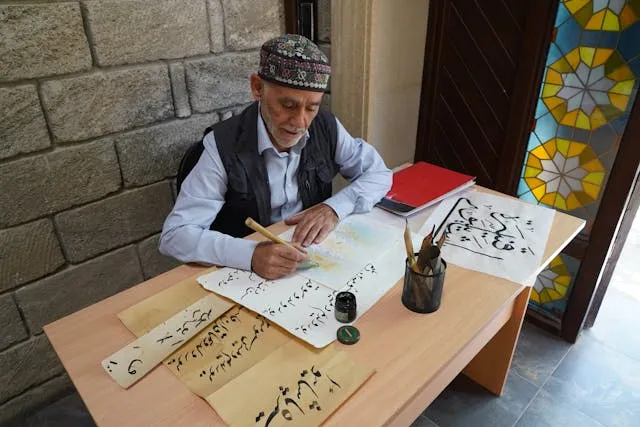
What an Online Calligraphy Class Usually Looks Like
Each session is live, one-on-one, and very hands-on. Our teachers don't just talk; they also listen, give feedback, and support us. This is what happens in a regular class:
How the class is organized:
Start (2 minutes): Review the homework from last time and set a goal for today.
One rule only, like "the alif leans back in Thuluth," for the theory bite (5 min).
For guided tracing (10 minutes), the teacher shows the screen or holds up a piece of paper to the camera.
Writing on your own (15 minutes): You write, and the teacher corrects your voice.
Put your work next to the master model and compare (8 minutes). Looking at the differences.
Homework and closing du'a (5 minutes)—a clear, doable task for the week.
Teaching Method:
Live mark-ups, slow-motion replays, checks on hand angles, and pictures of progress every week. We keep track of all of your classes.
Who Should Take This Class?
Children (4 years and older)
-
Lessons that are fun and interesting for young learners
-
Teachers who are kind and patient
-
Short sessions to help kids stay focused and creative
Adults (for beginners)
-
Begin at absolute zero
-
Learn at your own speed
-
Flexible hours for busy schedules
People who love art and want to learn about Islamic history
-
Great for people who like Arabic calligraphy
-
Learn how to write beautiful traditional scripts.
-
Improve your creativity, focus, and artistic skills
People Who Like to Do Things as a Hobby
-
Great for people who like design, writing, or traditional arts
-
Get expert help learning classic styles of calligraphy
-
Make a hobby a useful skill
Class schedule that can be changed (available all over the world)
United States and Canada: Every day of the week, slots are open in the early morning, afternoon, evening, and late at night.
There are sessions every day of the week in the morning, afternoon, and evening in the UK and Europe.
Middle East: There are classes every day of the week, five days a week.
Five days a week, all day long, Pakistan and India are open.
Australia and New Zealand: There are sessions every day of the week in the morning, evening, and night.
A Learning Plan Just for You
You can choose a schedule that works for you, with 2, 3, 4, or 5 classes a week, depending on when you can go and what you want to learn.
Get Started in Minutes
Starting to learn with us is simple. Follow these three simple steps:
Step 1
Choose Your Course
Look at our list of online Islamic and Quran courses, Noorani Qaida programs, Tajweed classes, and professional Islamic studies. Pick the class that will help you reach your spiritual and learning goals.
Step 2
Register Online
Fill out our simple registration form to apply right away. If you give us your information, our system will find the best teacher for you. Get an immediate confirmation and clear steps on how to begin.
Step 3
Learn and grow
You can learn at home when you want to. With structured lessons, one-on-one live classes, interactive exercises, and help from experts, you can learn about Islam, read the Quran, and learn the rules of Tajweed.
Finish Your Journey with Al-Huda Digital
This is just the beginning of your learning journey. At Al-Huda Digital, we believe in holistic growth through creativity, discipline, and skill development.
Need Guidance? Try Our Counseling Services
Life comes with challenges. Our professional Islamic and psychological counseling services provide support for:
-
Stress, anxiety, and depression
-
Marriage and family issues
-
Spiritual guidance
-
Parenting challenges
*Get 1-on-1 confidential sessions with qualified counselors.*
Want to Earn from Home? Learn Digital Skills
Turn your knowledge into income. Our digital skills courses help you:
-
Start freelancing and earn online
-
Build websites and design graphics
-
Learn SEO and social media marketing
-
Start your own online business
Perfect for students, housewives, and graduates.
Frequently Asked Questions
The purpose of our Frequently Asked Questions section is to provide you with straightforward and clear answers to questions about studying the Quran, Islamic studies, and online education. A lot of students and parents want to know about our classes, how we teach, how much they cost, and how to get started.
Here are short, easy-to-read answers to common questions. This is for parents looking for Quran classes for their kids, adults who want to learn Tajweed, or anyone else who is interested in Islamic studies.
No. Your first two weeks use a simple bamboo qalam, bottled ink, and smooth A4 paper (under $15 total). We also teach tablet-based calligraphy if you prefer digital.
Yes. We have specialized instructors who teach left-handed qalam angles and paper positioning. The rules of mizan remain the same.
We teach the Islamic science of khatt – including the spiritual adab (not wasting ink, not signing work with arrogance). Art courses skip this entirely.
Yes. Kids start with large-format Naskh using markers, then transition to qalam. Many “messy” writers excel because calligraphy is about shapes, not handwriting.
After completing advanced modules (usually 12–18 months), you can request an ijazah in a specific script. This is optional and requires a final composition exam.
We keep rates low by offering no recorded-content “courses.” You pay only for live 1-on-1 time. Most students take 2 classes/week. One class costs less than a fast-food meal.